Tuesday, August 2, 2016

Maintenance Gleaning for All, by Celia Hurvitt

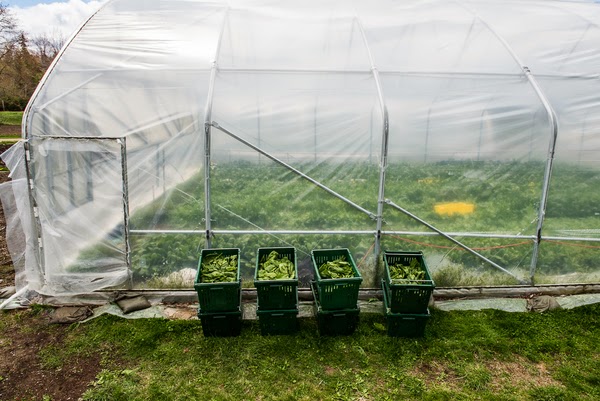
A few weeks ago while thinning beets at Jon Hyk’s garden, I was introduced to the term “maintenance gleaning.” While supporting the farmer’s need to create more space for a row of beets to grow, we thinned out the smaller plants, harvesting beet greens for the local Bucksport Community Concerns Food Pantry. 
The Gleaning room filled with beet greens from our day at Jon Hyk’s garden. 

Tuesday, July 5, 2016

The Gleaning Intern Returned, by Celia Hurvitt

            Over the past couple weeks of emerging summer, I have been out gleaning at many distinct farms around Hancock County. From John Hyk’s rows of spinach at his market garden in Prospect, to Runwater Farm’s plot of deer tongue lettuce, Four Season Farm and Beech Hill Farm greenhouses, each of the farms we have gleaned at has a particular nuance that I have had the joy of exploring.
It was only last June that I went out gleaning for the first time. At Pat and Mike’s Garden, in Ellsworth, we were greeted by a slobbery sweet dog and a cheerful invitation from its owner: “Take that whole row of lettuce,” and “do you need to use the hose? Would you like anything to snack on?” Katie and I spent a few hours amongst their beds, getting our knees covered with dirt and salvaging the seconds greens not fit to be sold. Once we finished  filling our yellow crates to the brim with fresh heads of lettuce we reluctantly left, lingering to pat the dog on the head and hoping we could come back soon.

Monday, June 13, 2016

Gleaning and FarmDrop Updates

Last month we held a lively community launch reception for FarmDrop.org farmers, customers and partners at Fairwinds Florist downtown Blue Hill. A beautiful assortment of delicious plates accompanied the festivities, including Quill's End Summer Sausage, Yknot Lamb Balls dipped in Goat's Milk Yogurt, Blue Hill Blondes Beef Liver Pate, Backstage Farm Kvas and Firestarter Kimchi, Four Season Farm Radish and Kale dipped in olive oil and sea salt, and sparkling grape juice made from gleaned grapes.

Customers who were picking up their FarmDrop order could spend a minute tasting some of the products available on FarmDrop.org and talking to farmers they don't usually get to interact with given the online nature of our marketplace. As we grow to include more farmers and customers our hope is that we can continue to hold occasional Meet-and-greet events like this to strengthen the FarnDrop community, discuss and new developments regarding the online platform, and continue to work together to build vibrant local food communities. This will be our third week open and we have hosted 30 online shoppers so far with more orders coming in every day. All proceeds go towards supporting the FarmDrop operations and the ongoing work of partners Healthy Acadia and Healthy Peninsula to get good food to all community members.

Guests at the FarmDrop Community Launch: includes Tina Allen(front left) of the Blue Hill Chamber of Commerce, Representative Ralph Chapman (front middle), and Janet Lewis (front right) of partner organization Healthy Peninsula and the Magic Food Bus.


To get involved in gleaning projects on farms and in your community, to share the bounty of the local harvest, get in touch with us at hannah@healthyacadia.org and visit our facebook page: https://www.facebook.com/thegleaningintiative/ or our website: http://www.healthyacadia.org/initiatives/gleaning.html 

Thank You!

Saturday, April 30, 2016

Blue Hill Blondes - A FarmDrop.org Farmer Story

Blue Hill Blondes John and Betty Tyler sell over 1000lbs of grass-fed USDA beef every year, to restaurants and individuals in Blue Hill, and through www.FarmDrop.org These farmers choose to serve smaller markets in order to maintain a one cow per acre quality space ratio. The most important part of their work is keeping the hay dry, the grass healthy and the cows happy.


Friday, April 8, 2016

Consumers to the food rescue! by Grace Burchard

We all know food waste happens; we throw away last week’s leftovers or leave bananas on the kitchen counter until they are black. Wasting food is somehow condoned: “It’s not that much food I’m wasting, right?” The recently released ReFED report, A Roadmap to reduce U.S. Food Waste by 20%, shows that U.S. citizens throw away 27 million tons of food waste every year, which has a value of 144 billion dollars. 
(A Roadmap to reduce U.S. Food Waste by 20%, 2016, p.11)


Monday, November 23, 2015

Clean Girls & Dirty Carrots, by Catherine Nichols, Somerset Public Health


"As a brand new AmeriCorps Volunteer in Service to America (VISTA) working for the Anti-Hunger Opportunity Corps at Somerset Public Health I was excited to start working towards an increase in food security for Somerset County. My supervisor was really excited for me to create a volunteer gleaning program for the county, but there were two problems…
Carrot gleaning at Kate Mrozicki's Morgan Bay Farm

Saturday, October 17, 2015

Wild Apple Stories

"It takes a savage or wild taste to appreciate a wild fruit." (Henry David Thoreau, Wild Apples)

From light soft yellow in our backyards as we wake up to the end of summer, to wild red orange and pink tones coating the sides of our repaved roads; and then the bright green popping out from the woods leading us home from work at dusk.

Tuesday, August 25, 2015

Owed to Interns


When you two spectacular ladies were introduced to gleaning for the first time this Spring, I had no idea you would become the essential part of the Hancock County Gleaning Initiative's 2015 season that you are. Without you out there gleaning this season there would have been three times less food, sometimes it would not have happened, it certainly would not have been so fun, and there would certainly be fewer gleaning girl jokes, #getitgirl. And not to mention the amazing vegetable rhymes we all came up with. I saw laughter and I saw tears, but who I really saw was you my dears!
 
The following was written by special guest blogger, Katrina Fennelly, who spent her summer break from college interning with Healthy Acadia’s Gleaning and Healthy General Stores Initiatives.


Wednesday, May 20, 2015

Spinach Revisited

Exactly two years ago to this day I fumbled my way through a row of spinach at Four Season Farm, getting a grand total of 8lbs of spinach, most of which got taken to the Emmaus Center in Ellsworth. Eliot Coleman set me up with a knife and some plastic bags and showed me what to do. I filled two bags and quit; honestly it felt a little strange. I remember using the spinach to bribe my first volunteers, giving a bag of spinach to anyone at the University of Maine Cooperative Extension 2013 Plant Sale who would sign up to be a gleaner.

This Spring 2015 we have exceeded our spinach gleaning expectations and increased by 50 times the amount gleaned in 2013. With crates, and harvesting knives, a lot more experience and 5 powerful volunteers (Kristin Witting, Paula Mrozicki, Little D, Christina Fortin and Katrina Fennelly) we gleaned 25 crates of spinach, were able to distribute 450lbs (4500 servings) to 10 food pantries and meal sites, reaching over 1,000 families in Hancock County through the following food security organizations: Simmering Pot Community Meal and Tree of Life Food Pantry in Blue Hill, Bucksport Community Concerns Food Pantry, H.O.M.E Co-op in Orland, Dinner is Served and Island Pantry in Deer Isle & Stonington, The Welcome Table, Emmaus Center and Loaves and Fishes Food Pantry in Ellsworth, and the Bar Harbor Food Pantry. All pantries and community meal sites that were open last week were contacted, others who were not open were not contacted; more will come. Thank you all for the amazing work you do to address food security in Hancock County. Contact your local food pantry by going to Healthy Acadia's website - http://www.healthyacadia.org/initiatives/documents/ExtensionHAFSO11_19_2014.pdf

Healthy Acadia and UMaine Cooperative Extension's Gleaning Initiative serves over 30 food security organizations in Hancock and Washington counties. Please be in touch for more information at hannah@healthyacadia.org / (207) 667 7171

NOTE: The pictures below were taken and provided by Brendan Bullock, a photographer who is working on a collaborative project commissioned by the Mainers Feeding Mainers Program of Good Shepherd Food Bank, and Maine Farmland Trust, documenting food access projects in Maine.


Wednesday, December 17, 2014

The Apple Story

October 17th, 36 volunteers gleaned at Johnston's Orchard.


We got 5,235lbs of apples from Johnston's...

...and 150L of Cider from Joe Tracy's community cider pressing.
Joe Tracy's apples go from his truck into a bleach solution;
a mechanized grinder pulverizes the apples;
buckets of apple mix getting dumped into the cider press...
(Joe Tracy's custom made cider press)
...and finally "the twist" produces the juice.
Stay tuned for plans to grow this five year tradition of apple gleaning and processing into an event for the community at large in 2015. The more apple varieties the better the cider, and certainly meal sites can best be served with a healthy drink already made than too many apples in their limited storage.

This year we distributed 5,000lbs of apples to pantries and 60L of cider to meal sites. 
Thank you gleaners and community members for making this possible.

Happy Holidays to all, see you in 2015!

Hannah & The Gleaning Team


Monday, October 20, 2014

Making History: Gleaning for Community Development

The U.S. Department of Economic and Community Development says:

"CONGRATULATIONS to the State of Maine Department of Economic and Community Development for being awarded the 2014 COSCDA Sterling Achievement Award for Community Development for the Hancock County Gleaning Initiative" (DECD).

The Maine Department of Economic and Community Development sponsored the Community Development Block Grant that enabled Healthy Acadia and UMaine Cooperative Extension to launch the Gleaning Initiative in 2012. The award was presented at the Annual Training Conference at the Boston Park Plaza Hotel, and was bestowed during the Presidential Reception and Award Recognition Ceremony on Tuesday, September 16, 2014 at the Boston Public Library. It was a small and beautiful event.


This might be the first time that gleaning efforts have been officially recognized nationally as an award-winning strategy for community development. However, gleaning has been on the national agenda before. Dan Glickman served as the United States Secretary of Agriculture from 1995 to 2001. Under the Clinton Administration, Glickman promoted Gleaning and Food Recovery by organizing conferences, passing The Good Samaritan Food Donations Act, and building a national network of gleaning organizations. We could probably trace a relationship between these national efforts and the success of Maine's Good Shepherd Food Bank food redistribution programs, as well as claim that the University of Maine Cooperative Extension put gleaning on their agenda as a product of these efforts. 

Should gleaning be national policy for hunger relief? If stripped of all its community-building, educational, and other value-added aspects, is gleaning, strictly economically speaking, worthwhile? (or sustainable?)
Some of the other gleaning organizations in New England such as the Boston Area Gleaners calculate the input-output ratio for each of their gleaning opportunities to decide whether or not to make the investment. There are overhead, gas, wear and tear on vehicles, time and effort, sorting and distribution costs, as well as a myriad of transaction costs to consider for gleaning opportunity; are those costs off-set by the pounds of food going to hungry people? Are we using speculative market prices to define value here?

Strategic management theory, based on economic decisions about the worth of any given gleaning opportunity, is one angle from which to consider the return on investment of gleaning. But in terms of what each gleaning opportunity produces, to put it in economic terms, there is a social and environmental return on investment (SROI and EROI) that needs to be measured first. I would even put my neck out to say that there is an emotional return on investment when the hopeful nature of gleaning raises the spirits of local farmers, pantry volunteers, non-profit organizers, policy makers, and the families of those who bring home fresh vegetables gleaned especially for them and/or by them, at the end of the day. 

I believe gleaning can make it back onto the national agenda, not only as a food waste prevention effort but also as a recognized award-winning community development strategy that puts the social, environmental and economic return on investment on an equal playing field.

Tuesday, September 2, 2014

The Pig Idea


This is not my big idea, by the way. But what are we, if not mosaics of stolen pieces of other people's brilliance and inspiration? Tristram Stuart, a professional gleaner in the UK was horrified at an early age by the amount of food waste in his school cafeteria, and began feeding the food scraps to his pigs, and feeding his community some of the often overlooked, but still delicious pig-parts. He is now a famous gleaner responsible for the many “Feeding the 5000” events that have taken place around the world.

One local version of this same brilliance comes in the form of Chris Brown of Brown Family Farm in Bar Harbor. Chris has been gleaning from Hannaford Supermarket to feed his pigs and support a Community Meal, which he organizes every Thursday from 3-6pm at the Holy Redeemer Catholic Church in Bar Harbor. Another pioneer is Stewart White of White's Farm in Monroe, who until recently would pick up school food waste to take back to the farm, taking his piglets along for the ride for the kids to experience. Unfortunately, Stewart is too worried about what is being fed to the kids to actually feed the scraps to his pigs; he also gets no return from this activity. However, virtually anyone who has pigs and birds at a non-commercial level is doing some form of gleaning: that is repurposing food in quality appropriate ways. In order to ensure quality and to support the many decentralized gleaning systems that are developing throughout Downeast Maine, the Gleaning Initiative is developing a Community-Based Gleaning Guide to meet the needs of partners in all food sectors across the region.

For the sake of context, we are in the second chapter of the Gleaning Initiative's Exploratory Phase. The first chapter was a time for networking, outreach, community-building, and on-farm gleaning. This second chapter adds in farmers’ market gleaning, restaurant food waste prevention, retail-to-pantry, on-farm resource-based consulting, surplus management, marketing, and transportation. We are expanding to Washington County, and we have also just recently added our first official processing experiment. 

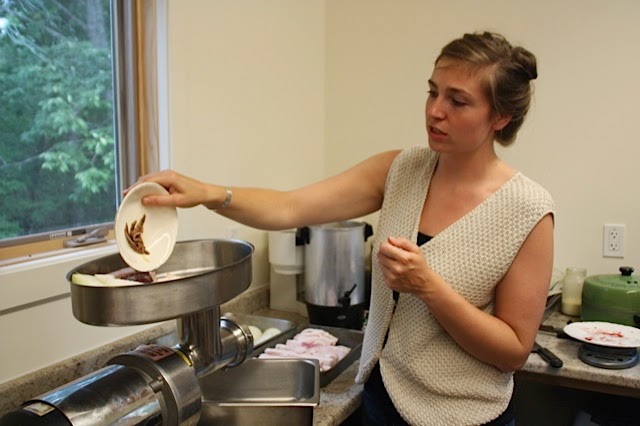
Deborah Evans of Bagaduce Farm is an incredible community player. From the beginning, she has bought in to the gleaning idea, and we have had many a conversation about how to include different versions of The Pig Idea. We worked with David's Folly Farm to raise money for two pigs for the Tree of Life, thanks to the Aragosta at the Barn event for which Deborah donated a pig (see June post in A Girl's Got to Glean). We have had informal gatherings to taste headcheese and pick the pig heads to make pork tacos. We have grilled pig tails and eaten them ¨like popsicles¨, by suggestion of Aragosta Sous Chef Susannah Taylor. Most recently, led by Deborah Evans, we had our first official processing workshop and made a Danish pig liver pate at the Halcyon Grange in North Blue Hill, for which we had seven participants from the ages of 6 to 65. 

To follow the recipe see: http://www.food.com/recipe/danish-pork-liver-pate-13895


As we continue to think about the many creative ways in which we can rescue and repurpose food that is otherwise going to waste, the question arose of whether we could use frozen pig liver to make pate. Interestingly enough, people who were connected to one of the seven volunteers who joined the workshop at the Halcyon Grange loved it. Others to whom the product was presented to without context, maybe not so much. Some wise palates say that frozen pork liver is not ideal, or that purely pork liver pate is in fact liver pasté, generally accepted as a Northern European traditional food that would be a very different taste for many of those raised on an American diet. Is this something worth putting a lot of energy into? What are the health benefits of eating liver? Maybe we can do it again and have a tasting of the different variations of the recipe and decide next steps. I can just see Bagaduce Farm celebrating the 10th Annual Pork Pate Pop-Up Party in Blue Hill Maine. 

Imagine... got liver?

______________________

Check us out in the news!

NATIONAL - http://newsdef.nbcnews.com/_news/2014/08/20/25505636-gleaning-americas-farms-unused-crops-feed-hungry-families#th4131487-c84944874


REGIONAL - http://bangordailynews.com/slideshow/gleaning-program-puts-garden-surplus-on-tables-helps-fight-food-insecurity-in-hancock-county/

LOCAL - http://weeklypacket.com/news/2014/aug/28/gleaning-initiative-connects-farm-produce-with-peo/#.VAYPTUgU7Xc

Wednesday, June 25, 2014

Aragosta at The Barn


When the moments that move us become memories, we become transformed. It is on the backbone of these shared narratives that we then imagine our life stories into being. The magic of the experience of Aragosta at The Barn at David’s Folly Farm has been for a month now carefully wrapped up in my back pocket. Spring has flung us all forward with a wave of her wand and busy activity has inundated our lives. The story of Aragosta at the Barn still resonates.


The $4,750 collected from this event was only a small part of what was raised throughout the night. For one, there was an encore of raised glasses and cheering, filled by Montroig Cava from the Blue Hill Wineshop, infusing renewed hope and high spirits into the food security initiatives of the Blue Hill region. Our community of non-profits and community members became intricately linked to the issues of food insecurity, as our palates shared in the bountiful culinary genius of Chef Devin Finigan of Aragosta and her amazing team. Living the contradiction of the experience of bounty as it relates to hunger was perhaps the most thought provoking aspect of this dinner experience.


The Tree of Life Food Pantry, Healthy Peninsula, Healthy Acadia, and UMaine Cooperative Extension all collaborated in the organization of the event, and the Gleaning Initiative (a program of Healthy Acadia in partnership with UMaine Cooperative Extension) took on a lead coordinating role together with Tree of Life. But it was through Aragosta’s deep connection to local food providers and Devin’s role as board member of the Island Culinary and Ecological Center (ICEC) that we were able to inspire such generous donations, and bring such a wonderful crowd together.

As we backtrack through the story of Aragosta at the Barn, it is precisely The Barn at David’s Folly Farm that I would like to thank the most. John and Emma’s vision of wanting more of their locally raised animals in the food pantry, and their commitment to filling more local people’s freezers with good sources of local protein, had Rick Traub of Tree of Life, and myself, a gleaner and pantry board member, convinced from day one. The Pantry's Pig Idea brings up an important question that our community of farmers, butchers, processors, teachers, chefs, representatives, community members, volunteers, folks in need, summer residents, fisherwomen, pastors, store owners, service providers must come together around, to find a way, or many ways, to make local food economies thrive again, and again, and again, for years to come?

Of course the vegetables of the Magic Food Bus and the Double Your Benefits Program at the Blue Hill Farmer's Market are not forgotten, but isn't it time we went whole hog!?

A special thank you to William Altman for all the photos that are shared here, and last but not least a very special thank you to Eric Horschak for the bountiful music played during the event.